🐾
Topic Introduction: Pets & Companions
Quick look into the theme
click to open / close
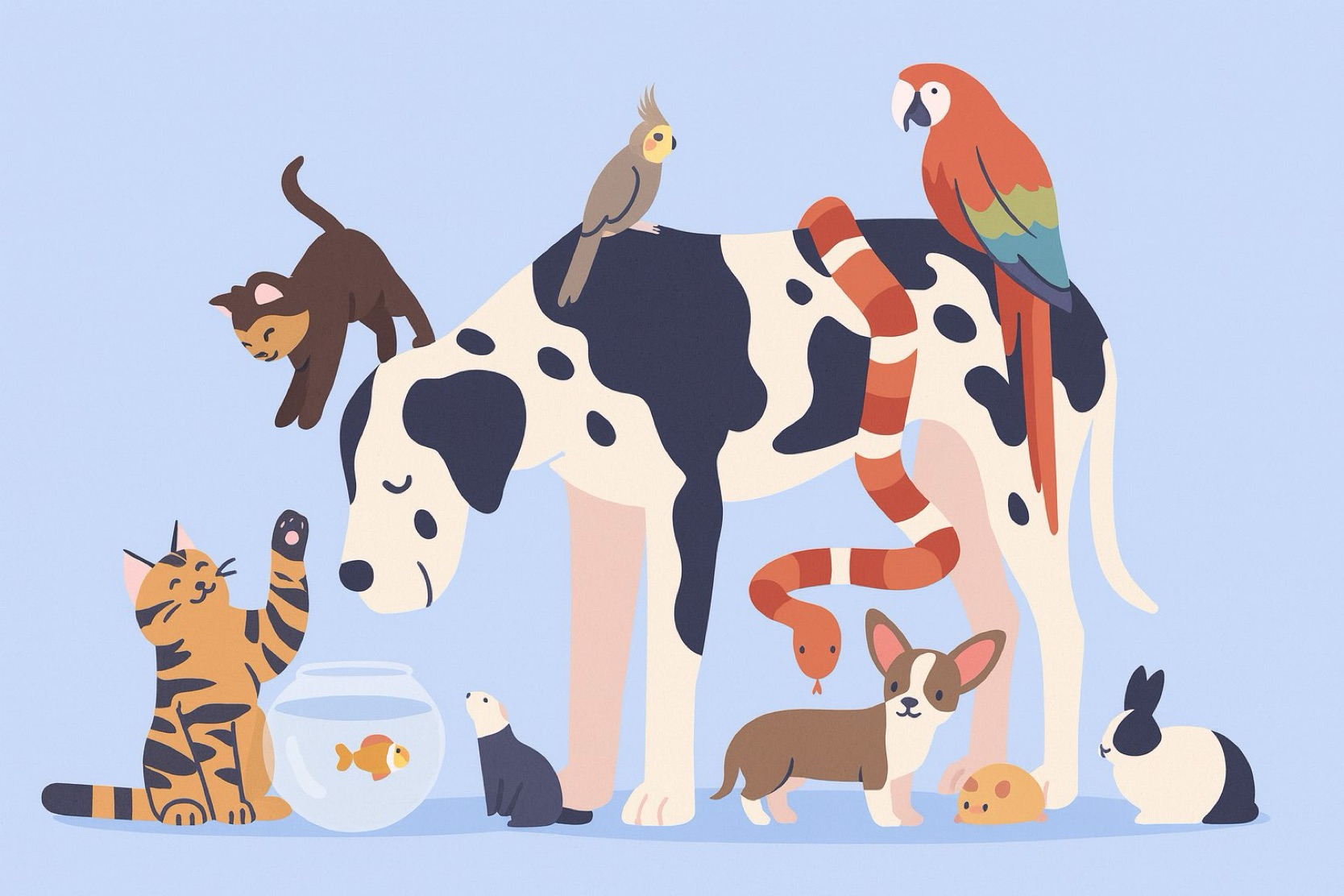
Quick Look: Pets bring companionship, joy, and sometimes challenges into our lives. They shape cultures and daily routines across the world. This topic explores the role of pets in human life, language, and learning.
Recommended Level: A2–B1
? How to use this material
For Teachers
- Begin with a warm-up question or activity to activate background knowledge.
- Choose 1–3 modules to focus on for each lesson, depending on time and student needs.
- Encourage students to think first before revealing extra tips or answers.
- Use the expandable notes and links for deeper discussion or extra practice.
- Screenshot the notes or key sections and share them with students after class.
A single topic can easily extend over 3–4 lessons.
For Self-study
- Start with the warm-up to get your ideas flowing.
- Work through 1–2 modules at a time — don’t rush; each can stand alone as a short study session.
- Always guess or think first, then expand the tips/answers to check yourself.
- Add examples or questions in the notes boxes to make your own study record.
- Review your notes/screenshots later to build a personal glossary and practice log.
One topic can stretch across several days of practice.
▶ Optional Video
? Warm-up question
What kind of pet do you have or would like to have? Why did you or would you choose that pet?
Topic Introduction: Pets & Companions
Quick look into the theme
Quick Look: Pets bring companionship, joy, and sometimes challenges into our lives. They shape cultures and daily routines across the world. This topic explores the role of pets in human life, language, and learning.
Recommended Level: A2–B1
? How to use this material
For Teachers
- Begin with a warm-up question or activity to activate background knowledge.
- Choose 1–3 modules to focus on for each lesson, depending on time and student needs.
- Encourage students to think first before revealing extra tips or answers.
- Use the expandable notes and links for deeper discussion or extra practice.
- Screenshot the notes or key sections and share them with students after class.
A single topic can easily extend over 3–4 lessons.
For Self-study
- Start with the warm-up to get your ideas flowing.
- Work through 1–2 modules at a time — don’t rush; each can stand alone as a short study session.
- Always guess or think first, then expand the tips/answers to check yourself.
- Add examples or questions in the notes boxes to make your own study record.
- Review your notes/screenshots later to build a personal glossary and practice log.
One topic can stretch across several days of practice.
▶ Optional Video
? Warm-up question
What kind of pet do you have or would like to have? Why did you or would you choose that pet?
📝
Word Training
Vocabulary Practice
click to open / close
Word Training
Vocabulary Practice?How to use this section
Goal: Build practical vocabulary by exploring examples, defining in your own words, and using the word in discussion.
- Select a word → read the Example sentence carefully.
- In your own words, explain the meaning or give another example → then reveal the Definition to compare.
- Answer the Discussion question in as much detail as possible, using the new vocabulary word naturally as you speak or write.
- Challenge: use the word in 2 different contexts (e.g., a personal example and a general statement).
1Companion
Definition
Discussion question
Notes / Answer
2Responsibility
Definition
Discussion question
Notes / Answer
3Adoption
Definition
Discussion question
Notes / Answer
4Shelter
Definition
Discussion question
Notes / Answer
5Allergy
Definition
Discussion question
Notes / Answer
6Grooming
Definition
Discussion question
Notes / Answer
❔
What’s the Question?
Reverse Q&A
click to open / close
What’s the Question?
Reverse Q&A?How to use this section
Goal: Practice forming questions by working backwards from given answers.
- Read the Answer.
- Think of a Question that could produce this answer.
- Remember, there may be more than one correct question. If you get stuck, open the Tip bank. Check Possible Question(s) last.
When (time) • Where (place) • Who (people) • Why (reason) • How many / How much (amount) • How often (frequency) • If / Would (conditions)
AI adopted my dog from a shelter three years ago.
Tip
Possible Question(s)
AI feed my cat twice a day and brush her fur every evening.
Tip
Possible Question(s)
ANo, I don’t have any allergies to animals.
Tip
Possible Question(s)
ABecause walking my dog helps me relax after school.
Tip
Possible question(s)
AThe small carrier is mine; the big one belongs to my brother.
Tip
Possible Question(s)
AThey can live up to 15 years if they’re healthy.
Tip
Possible Question(s)
AIf I had more time, I would volunteer at the animal shelter.
Tip
Possible Question(s)
👍👎
What do you think?
Agree / Disagree
click to open / close
What do you think?
Agree / Disagree?How to use this section
Goal: Develop debate skills by taking a stance, giving reasons, and supporting your ideas with evidence.
- Open a card and read the statement carefully.
- Decide your stance: Agree or Disagree.
- Give at least two reasons and support them with evidence — an example, story, or data.
- Optional: switch sides and argue the opposite view to practice flexible thinking.
1
Every child should grow up with a pet.
AGREE
Notes / Answer
Support Notes
DISAGREE
Notes / Answer
Support Notes
2
Pets are better companions than people.
AGREE
Notes / Answer
Support Notes
DISAGREE
Notes / Answer
Support Notes
3
Spending a lot of money on pet fashion and pet hotels is a waste.
AGREE
Notes / Answer
Support Notes
DISAGREE
Notes / Answer
Support Notes
4
Make your own statement now!
AGREE
Notes / Answer
Support Notes
DISAGREE
Notes / Answer
Support Notes
5
Make your own statement now!
AGREE
Notes / Answer
Support Notes
DISAGREE
Notes / Answer
Support Notes
💬
Discussion Questions
From answers to full discussions
click to open / close
Discussion Questions
From answers to full discussions?How to use this section
Goal: Practice thoughtful speaking and writing by answering questions in depth, making connections, and using new vocabulary.
- Choose a question — they become more challenging as you go down.
- (Optional) Tap Follow-ups to extend the conversation.
- Go beyond short answers: include personal stories, memories, or opinions. You can also connect ideas to movies, books, TV shows, or current events.
- Make sure to use the new vocabulary from earlier in the lesson to strengthen your answers.
- Click Answer to write your response or add notes.
1
If you could have any pet, what would you choose—and why?
Easy
Follow-ups (tap to select)
Answer
2
What pets are common and uncommon where you live?
Easy
Follow-ups (tap to select)
Answer
3
How much time and money does basic pet care take each week?
Moderate
Follow-ups (tap to select)
Answer
4
What qualities show that someone is ready to own a pet?
Moderate
Follow-ups (tap to select)
Answer
5
Should schools or workplaces allow pets sometimes? When might it help—or not?
Moderate
Follow-ups (tap to select)
Answer
6
How can pets influence a child’s development and responsibility?
Moderate
Follow-ups (tap to select)
Answer
7
Is it better to adopt from a shelter or buy from a breeder? Why?
Challenging
Follow-ups (tap to select)
Answer
8
Where should we draw the line on owning exotic pets?
Challenging
Follow-ups (tap to select)
Answer
9
During disasters or housing crises, how should communities support pet owners?
Challenging
Follow-ups (tap to select)
Answer
10
If animals could express consent, how might pet ownership change?
Hard
Follow-ups (tap to select)
Answer
11
It’s your turn — What’s your question?
Student
Follow-ups (tap to select)
Answer
12
It’s your turn — What’s your question?
Student
Follow-ups (tap to select)
Answer
13
It’s your turn — What’s your question?
Student
Follow-ups (tap to select)
Answer
💡
Expressions & Idioms
Click to explore, learn, and discuss
click to open / close
Expressions & Idioms
Click to explore, learn, and discuss?How to use this section
Goal: Learn to understand and use expressions or idioms by exploring their meaning, practicing them in context, and making them part of your own language.
- Choose an expression or idiom to focus on.
- Read the Example sentence and try to guess the meaning.
- Reveal the Definition to check your understanding.
- Answer the Discussion question, and try to use the expression/idiom naturally in your response.
- Write down any notes, comments, or your own examples in the notes box.
Let the cat out of the bag
Example: She let the cat out of the bag and told everyone about the surprise party.
Definition
Discussion Question
Notes / Comment
Dog days of summer
Example: We spent the dog days of summer lounging by the pool.
Definition
Discussion Question
Notes / Comment
Curiosity killed the cat
Example: Don’t go snooping around in his office—curiosity killed the cat.
Definition
Discussion Question
Notes / Comment
Raining cats and dogs
Example: It was raining cats and dogs, so we had to cancel the picnic.
Definition
Discussion Question
Notes / Comment
Fight like cats and dogs
Example: My brothers used to fight like cats and dogs when they were kids.
Definition
Discussion Question
Notes / Comment
📰
Have you heard about…
Current topics | articles, videos, etc.
click to open / close
Have you heard about…
Current topics | articles, videos, etc.?How to use this section
Goal: Explore new topics by reading, building vocabulary, and reflecting through discussion and notes.
- Choose a topic and expand it to begin.
- Read the summary and quick facts. (Optional: visit the original source for more detail.)
- Tap Vocabulary to reveal meanings and see example sentences.
- Finish by reading and answering the Discussion questions in detail.
- Use My notes or per-question notes to write down your ideas, reflections, or new connections.
- Challenge: share your notes with a partner or record a short summary to explain the topic in your own words.
1
Therapy Animals
comfort & stress relief
Watch: What Do Therapy Dogs Do?
Therapy animals bring comfort and calm to people in stressful places like hospitals, schools, and nursing homes. Their presence helps lower blood pressure, reduce anxiety, and even improve communication in therapy sessions. These animals are trained to be gentle, patient, and responsive, creating small moments of connection that brighten someone’s day and support emotional healing.
- Therapy animals are trained for friendliness and calm (not the same as service dogs).
- Cats, rabbits, and even miniature horses can be therapy animals.
- Universities often offer “puppy rooms” during exam season.
My notes
2
Unusual Pets Around the World
exotic & uncommon
Read: BBC Earth — Raising the most unusual pets
From sugar gliders to hedgehogs and reptiles, people around the world raise surprisingly exotic pets. These animals often need very specific care — the right diet, temperature, and environment — to stay healthy. Some are legal in one country but banned in another, creating debates about animal welfare and ethics. Owning an unusual pet takes research, experience, and deep responsibility to ensure the animal’s safety and comfort.
- Some species are legal in one place and illegal in another.
- Unusual pets often require experienced owners and dedicated time.
- Ethics and welfare are big parts of the discussion.
My notes
3
Pet Fashion & Luxury
glamour or waste?
Read: The Guardian — Fashion houses turn to pet clothing
The pet fashion boom shows how deeply people connect with their animals — and how much they’re willing to spend. Luxury brands now design coats, collars, and even spa treatments for pets, calling it an expression of love and identity. Critics argue it reflects excess rather than care, while supporters say it celebrates companionship in a fun, creative way. The trend raises questions about comfort, ethics, and where to draw the line between affection and indulgence.
- Big brands now sell premium lines for pets.
- “Humanisation” of pets drives demand for outfits and services.
- Debate focuses on comfort, safety, and values—not just style.
My notes
4
Rescue Stories
adopt, don’t shop
Read: FOUR PAWS — Rescue success stories
Animal rescues and shelters give second chances to pets in need — from dogs abandoned on the street to animals freed from poor conditions. These stories celebrate patience, recovery, and the kindness of volunteers who help them heal. Every adoption connects two lives: an animal finding safety and a person gaining a loyal companion. The rescue movement reminds us that care, not cost, defines what makes a pet truly loved.
- Rescues rely on volunteers, donations, and foster families.
- Adoption events and social media help pets get seen.
- Vets check health, vaccinations, and microchips before rehoming.
My notes
✅❌
True or False
Read, pick your guess, then reveal the facts.
click to open / close
True or False
Read, pick your guess, then reveal the facts.?How to use
Goal: Build reading and critical thinking skills by checking facts, exploring key vocabulary, and verifying information with reliable sources.
- Read the statement carefully. Hover over any bold underlined word to preview its meaning, or click to drop the full definition below.
- Decide whether the statement is True or False.
- Click Answer to check if you were correct and see an explanation.
- Follow the Source link to explore the topic in more depth.
1
Answer
2
Answer
3
Answer
4
Answer
5
Answer
6
Answer
7
Answer
8
Answer
9
Answer
10
Answer
✏️
Let’s Practice!
Activities drawn from this topic
click to open / close
Let’s Practice!
Activities drawn from this topic? How to use this section
Goal: Practice idioms, vocabulary, and key facts through a variety of interactive activities.
- There are 7 different activities to choose from, all connected to this topic.
- Click a word or phrase, then click a blank to place it. Click a filled blank to clear it.
- Press Check to see which blanks are correct ✅ or incorrect ❌, or use Show answers to reveal all.
- Text boxes begin small and auto-expand as you type your answers.
- Challenge: try more than one activity and compare how your answers improve over time.
1 Matching
2 Fill in the blanks
3 Words in Action
4 Say it another way
5 Writing practice
Prompt 1: Describe your favorite pet memory
Tip
Prompt 2: Should schools allow pets sometimes?
Tip
Prompt 3: Adopt vs. buy — what’s your view?
Tip
6 Vocabulary practice
Tip: tap a word in the bank, then tap a blank — or just type your own answer.
Show / hide word bank
7 Word / Phrase Chart
| Word/Phrase | Meaning | Example |
|---|
Share What You Learned — Join the Discussion
Students, teachers, and visitors: share something you learned, a comparison you made, or a question you still have. Post your answers in the comments — I’d love to hear from you!
If you’re not currently a student, you can still post your answers or any questions in the comments section on the page, and either myself or the community will respond.
If you’d like personalized lessons, feel free to sign up — I look forward to helping you reach your goals!
Sign Up for Lessons💡 Don’t forget to check back and see what others have to say!